Plantain chips, potato chips, and shrimp chips can lose commercial value when a seasoning machine creates excessive impact, long retention time, uneven loading, or uncontrolled powder addition. Thin fried products need enough movement to distribute salt, chili, barbecue powder, cheese seasoning, or other flavor blends, but the food handling system should not force fragile pieces through unnecessary drops and collisions. A continuous seasoning drum for fragile fried chips gives snack factories a controlled way to combine product movement, powder dosing, optional oil application, and continuous discharge. The final machine setting depends on chip thickness, expansion level, residual surface oil, seasoning formula, line capacity, and acceptable breakage rate.
Why Do Plantain Chips, Potato Chips, And Shrimp Chips Break During Seasoning?
Each chip type enters the seasoning stage with a different physical structure. Potato chips usually form thin rigid slices after frying, while plantain or banana chips can vary in thickness and hardness according to maturity and slicing design. Shrimp or prawn crackers expand rapidly during frying and develop a light crisp structure, so aggressive impact can damage the finished pieces. Wikipedia describes prawn crackers as starch-and-prawn snacks that expand during deep frying into a light, crisp texture, which explains why processors need careful post-frying handling. Prawn crackers that expand during deep frying therefore represent a useful example of a fragile snack format.
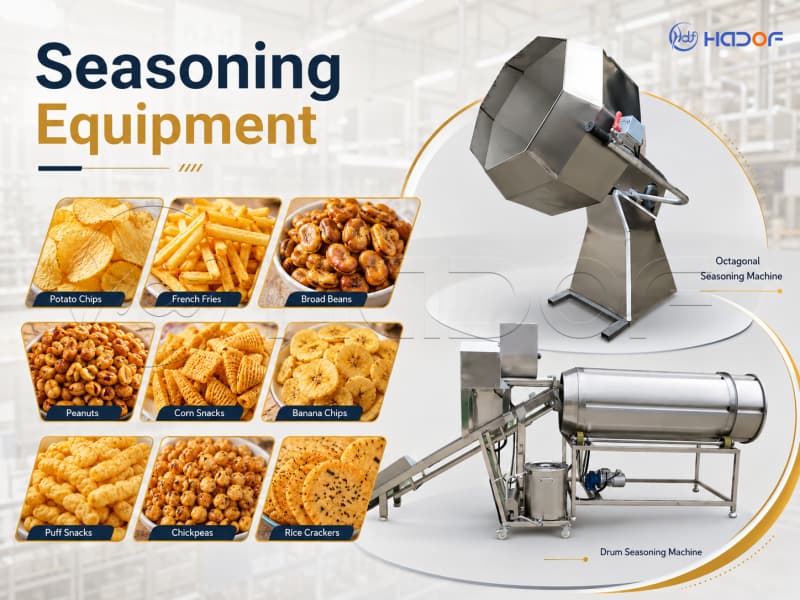
The seasoning equipment page explains that snack factories process potato chips, banana chips, shrimp sticks, puffed snacks, and similar products, and it highlights adjustable movement for product handling. The page also states that operators can adjust drum speed and barrel angle to control mixing time and product breakage in octagonal seasoning equipment.
Which Low-Breakage Snack Seasoning Equipment Controls Drum Speed And Retention Time?
A seasoning machine needs enough tumbling action to expose all product surfaces, but excessive rotation can increase edge chipping and breakage. The Hadof seasoning page describes two main designs: an octagonal seasoning machine for small and medium production and a rotary drum machine for continuous industrial food manufacturing. The octagonal machine creates multi-directional lifting, falling, and sliding, while the continuous drum moves products forward through the cylinder.
A low-breakage snack seasoning equipment with adjustable drum speed gives processors more control over residence time and collision intensity. Thin potato chips may need shorter retention and gentler movement than denser fried nuts. Plantain chips may tolerate slightly different rotation according to slice thickness and final moisture. Puffed shrimp chips need especially careful trial settings because their expanded structure can fracture under repeated drops. The food production team can therefore set drum speed, barrel angle, feed rate, and powder flow as one combined food processing procedure instead of changing one variable in isolation.
How Do Automatic Powder Dosing And Oil Spraying Improve Seasoning Adhesion On Fried Chips?
Seasoning adhesion depends on product surface condition before the chips enter the drum. The target equipment page states that warm fried food can hold powder more effectively and that some products need oil spraying before powder dosing. The same page explains that the powder-and-oil technique can improve adhesion and reduce flavor loss during conveying. Rotary seasoning equipment can also combine continuous product movement with automatic powder dosing and oil spraying.
An automatic powder dosing and oil spraying system for fried chips can help a food factory distribute seasoning more consistently while avoiding repeated manual additions. A stable dosing system also prevents local powder buildup that can force operators to extend mixing time unnecessarily. Longer mixing creates more product collisions, so accurate dosing can indirectly support lower breakage. This relationship matters for plantain chips, potato chips, shrimp chips, puffed snacks, and other fragile foods that need controlled food preparation after frying.
When Does An Industrial Rotary Flavoring Drum Fit A Continuous Snack Production Line?
Large snack factories usually need continuous seasoning rather than repeated manual batches. The current seasoning page gives HDF-2400 and HDF-3000 rotary models with reference inputs of 1,000 and 1,500 kg/h, respectively. The rotary design uses continuous forward movement, powder spraying, adjustable drum angle, and frequency-controlled rotation speed.
An industrial rotary flavoring drum for potato and banana chips therefore suits a food manufacturing process that already uses continuous frying, de-oiling, cooling, seasoning, and packaging equipment. Smaller factories with multiple flavors or shorter production runs may prefer an octagonal system because batch or semi-continuous operation can simplify flavor changes. Larger factories can favor rotary equipment when the production plan requires steady feed and continuous discharge. Product trials still matter because fragile plantain and shrimp-chip formats can require different speed and angle settings even when the hourly capacity remains similar.
How Should A Vibrating De-Oiling Machine Feed A Chip Seasoning Line?
Surface oil management affects both seasoning adhesion and product movement. Excess oil can cause powder clumping, heavy coating, or uneven flavor distribution, while insufficient surface oil can reduce powder adhesion for some recipes. A controlled de-oiling stage gives the seasoning drum a more consistent incoming product. The related vibrating de-oiling machine before snack seasoning removes surface oil through vibration and screening while the product moves forward. The page places a vibrating de-oiling machine between frying and downstream cooling or seasoning operations in typical fried food production.
Stable feeding also matters because sudden surges can overcrowd the seasoning drum and increase collisions. A vibrating drainer can connect with fryers, cooling conveyors, seasoning systems, and packaging machines, while suitable chutes help control transfer between each stage. This food handling arrangement helps factories coordinate frying, oil treatment, seasoning, cooling, and packaging as one continuous food processing system rather than several isolated machines.
How Can A Seasoning Drum Support Different Food Production And Flavoring Procedures?
A snack factory may produce salted potato chips in one shift, chili plantain chips in another shift, and shrimp-based puffed snacks in another production campaign. Each product requires a different relationship among drum speed, residence time, powder feed, oil spray, and throughput. The seasoning page identifies dry powder seasoning, spice mixing, optional oil spraying, and continuous rotary processing among its operating methods. It also covers potato chips, banana chips, fried nuts, puffed foods, shrimp products, and other sliced, granular, strip-shaped, or block-shaped foods.
Fried snack processing systems can connect seasoning machinery with pre-processing, frying, de-oiling, cooling, conveying, and packaging equipment. This complete food production design matters when an equipment buyer evaluates factory layout, food manufacturing capacity, labor requirements, cleaning management, seasoning changeovers, waste disposal, and future production expansion.
Which Seasoning Drum Configuration Fits Plantain Chips, Potato Chips, And Shrimp Chips?
A factory that prioritizes flexibility and smaller production runs can consider octagonal seasoning equipment because adjustable speed, barrel angle, optional oil spraying, and several discharge arrangements support frequent product or flavor changes. A factory that prioritizes continuous high-volume food production can consider a rotary drum because continuous feeding, powder dosing, adjustable drum angle, and frequency-controlled rotation create a steady post-frying process. The target product shape still determines the final settings.
Plantain chips need a trial that balances full surface coverage against edge damage. Potato chips need controlled tumbling that distributes powder without excessive cracking. Shrimp chips need particularly gentle transfer because their expanded crisp structure can break during repeated impact. Factories can learn more about seasoning equipment configurations when they compare batch and continuous solutions, powder dosing, oil spraying, drum speed, line capacity, and upstream de-oiling.
If project teams have interests in seasoning systems for plantain chips, potato chips, shrimp chips, or other fried snacks, they can learn more about:
https://www.friedfoodsolutions.com/seasoning-equipment/