A phosphate project can follow two very different commercial routes. You may upgrade mined rock into uniform granules, or you may convert it into SSP fertilizer through an acid-reaction process. A suitable phosphate ore fertilizer processing line therefore starts with the intended product, ore analysis and local market rather than the granulator alone.
Product Goals Define the Processing Route
Physical granulation offers a shorter route for mines and mineral suppliers that want easier handling, controlled particle size and packaged phosphate rock products. A 1–20 TPH phosphate fertilizer plant can combine crushing, grinding, batching, granulation, screening and packing according to the required output.
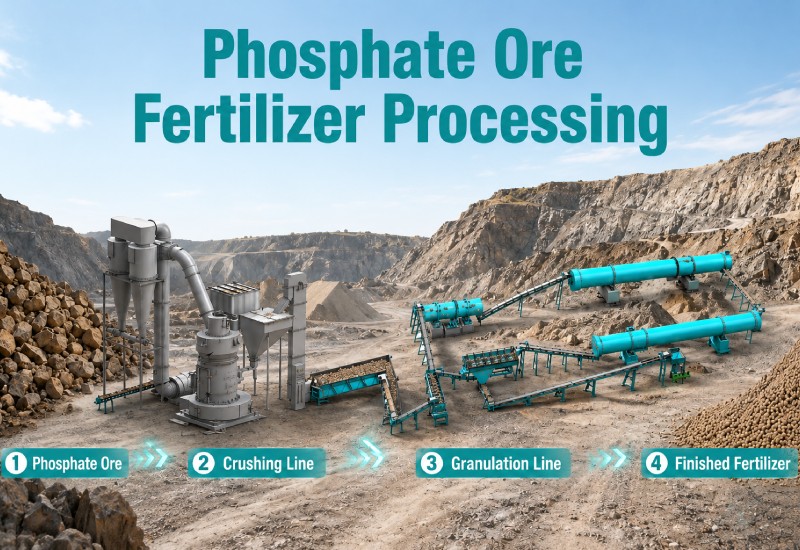
SSP production adds a chemical conversion stage. Single superphosphate is produced by reacting phosphate rock with sulfuric acid, so this route needs acid preparation, accurate dosing, reaction, curing and corrosion control.
Ore Preparation Supports Stable Production
Your ore grade and grinding result affect every downstream section. For SSP projects, the target page recommends phosphate ore with more than 30% P₂O₅ and powder finer than 100 mesh. A jaw crusher can reduce large rocks before a Raymond mill for phosphate rock completes fine grinding.
Moisture, hardness and impurities also influence equipment selection. Representative ore samples give the supplier a better basis for crusher capacity, wear-part choice and mill configuration.
Granulation Method Changes the Equipment Scope
A phosphate rock granulation system may use roller extrusion for a compact dry process or wet granulation for rounded pellets. Dry extrusion can reduce the need for thermal equipment when the feed already has suitable moisture. Wet routes normally add controlled liquid, drying, cooling and return screening.
The required pellet shape, 1–20 TPH capacity and available workshop space help determine whether a disc, stirring-teeth or rotary drum granulator fits the project.
SSP Production Requires Additional Process Control
An SSP fertilizer production project has a broader scope than physical rock granulation. The reference process uses concentrated sulfuric acid, dilution equipment, metered feeding and reaction mixing. It also allows approximately 20–60 minutes for reaction and two to four weeks for curing.
Because acid and corrosive vapors enter the process, material selection matters. PP acid tanks and corrosion-resistant contact sections can become more important than standard carbon-steel construction.
Capacity, Site and Budget Need One Plan
The page presents industrial phosphate processing equipment for 1–20 TPH projects, with indicative areas of 3,000–12,000 m² and budgets of $100,000–$1,000,000. Your final scope depends on:
- Ore composition, size and moisture
- Granular rock, SSP or GSSP product
- Required hourly capacity and pellet size
- Voltage, fuel and workshop dimensions
- Packing format and automation level
You can review the complete process options before requesting a layout and equipment list: